You tell your account manager the hero photo should be the commercial job, not the house. She writes it in a ticket. The ticket goes to a project manager, who schedules it for the next sprint, where a designer who has never spoken to you reads one sentence out of context and picks a different commercial photo. Three weeks later you get an email asking if that is approved.
Nobody in that chain did anything wrong. The chain is the problem.
What gets lost in the relay
When you talk directly to the builder, you do not just transmit instructions, you transmit reasons. "Use the commercial photo" is an instruction. "Use the commercial photo because residential is fine but commercial is where the margin is and I want the site to pull that kind of call" is a reason, and a reason produces better decisions on the fifty questions nobody thought to ask.
Reasons do not survive being written into a ticket. Instructions do. That is why relayed projects come back technically correct and somehow wrong.
There is a second cost, which is speed. A change that takes four minutes takes eleven days when it has to be queued, scheduled, reviewed and reported. Multiply by thirty changes and that is your whole timeline.
The honest counterargument
Layers exist for a reason. A studio with forty employees and eighty active clients genuinely cannot have every designer on every call, and account managers protect makers from constant interruption so they can actually make things. That is a real trade-off, not a scam.
The question is not whether layers are evil. It is whether you are paying for a structure that serves a company much larger than yours. If your project is a homepage, five service pages and a lead flow, the coordination overhead of a large agency is pure cost to you.
How to evaluate a studio in one conversation
Ask these before you sign anything. The answers are revealing and most of them are hard to fake.
- Who will I be talking to in week three? Not week one. Everyone is attentive during the sale. Ask specifically whether the person on this call is the person who will be doing and answering.
- Can I see something before I pay? Anyone can produce a portfolio of their best work. Very few will build something for you first. If a studio cannot show you your own homepage before you commit, ask why not.
- How many people touch this project, and what does each one do? A clear answer is a good sign either way. A vague answer means the structure is not designed, it is just accumulated.
- What happens when I want a change six months from now? Ask for the actual mechanism and the actual turnaround. "Submit a support ticket" and "text me" are different businesses.
- Do I own it? The domain, the content, the photos, the code. Get this in writing. Some arrangements leave you renting your own website, which becomes clear only when you try to leave.
- Show me a site you built for a business like mine, and tell me what it did. Not awards. Whether the phone rang.
- What do you need from me, and how much of my time? A studio that says "about two hours total" has a process. A studio that says "as much as you can give" does not.
The tells that are not about layers at all
- They talk about design and never about leads.
- They cannot explain, in plain words, what happens after someone fills in your form.
- Their own site is slow on your phone.
- They quote statistics with no source. If someone tells you 75% of consumers judge credibility on design, ask where that comes from. The real Stanford web credibility research says that visual design was mentioned in 46.1% of participants' comments about why they trusted a site, which is a specific, sourced, and much more careful claim. The difference between those two sentences tells you how the rest of the relationship will go.
- They bash their competitors more than they explain their own work.
What small should actually buy you
Small is not automatically better. A one-person shop that disappears for two weeks is worse than a well-run agency. What small should buy you is specific: the person who hears the problem is the person who fixes it, changes happen in hours, and there is no translation layer to lose the reasons in.
If a studio is small and slow, you are getting the downside without the upside. Ask about turnaround, not just headcount.
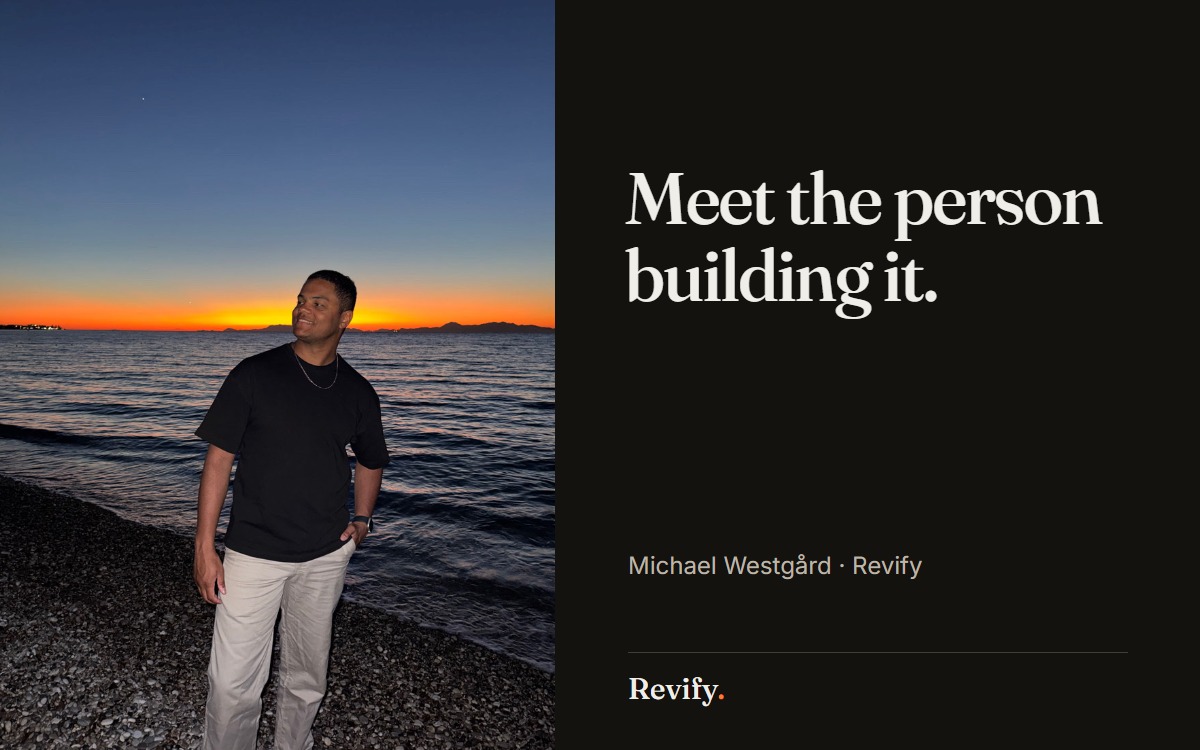
We work the way we do because it is the only way we know how to make something that fits a specific business. You talk to the builder, from the first call to the last change.
If you want to test it, ask us for the free 48-hour preview and see who answers.