Every contractor eventually has this conversation, usually with someone who has an obvious stake in the answer. So here is the version from a studio that builds custom sites and will still tell you when a template is the right call.
What a template genuinely gives you
Speed and price. You can be live in a week for a few hundred dollars, and modern templates from the major platforms are properly built - responsive, reasonably fast, accessible enough, secure by default.
They also give you something underrated: they stop you from making the classic disasters. A template will not let you set 11px grey body text on a white background, or forget the mobile layout, or bury your phone number. The floor is much higher than it was ten years ago.
For a brand-new company testing whether a market works, a solo operator who gets most work by referral, or anyone with real cash-flow pressure, a good template plus honest photos plus a properly filled-out Google Business Profile will outperform a lot of expensive custom work. That is not a consolation prize, that is just true.
What changes when it is built for you
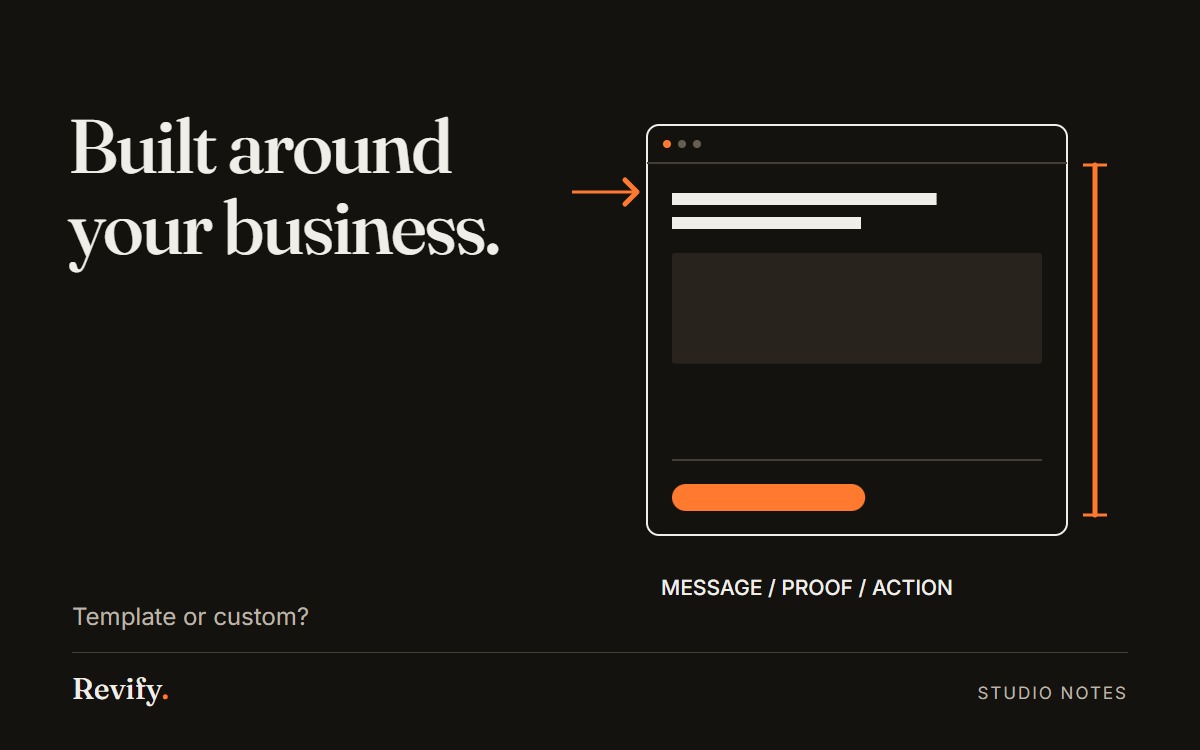
The structure matches how you actually sell. This is the biggest one and the least discussed. A template is built around a generic service business: hero, three service cards, testimonials, contact. But a roofer selling insurance-claim replacements has a completely different sales conversation than one selling cash retail repairs, and a template cannot know that. Custom means the page order, the questions answered, and the calls to action follow your actual path from stranger to signed contract - claim process explained before pricing, financing before spec, whatever your business requires.
Speed is a budget, not an accident. Template speed starts fine and degrades as plugins accumulate - the booking plugin, the review widget, the chat widget, the tracking scripts. Six months in, the homepage is 4MB and takes seven seconds on LTE. A custom build sets a performance budget at the start and everything that gets added has to fit inside it.
Photography gets treated properly. Your job photos are your single best asset and templates handle them generically - fixed crops, forced aspect ratios, a gallery grid. Custom means the before-and-afters are laid out to be read, the crops are chosen per photo, and the images are sized for the layout rather than uploaded at 4000px and scaled down in the browser.
Forms connect to your operation. A template form emails you. A built form can route by job type, ask the qualifying questions your dispatcher actually needs, fire an instant SMS, drop the lead into your CRM, and alert the right person. That plumbing is where speed-to-lead lives, and it is the part that makes money.
Service-area pages that are not spam. Most template approaches to local SEO produce twenty pages that are the same text with the town name swapped. Google has been unimpressed by that for a decade. Doing it properly means real content per area - actual jobs, actual neighborhoods, actual local specifics - which is a content problem, not a template problem, but a custom build is where it gets structured correctly.
You look different from your competitors. In most markets a handful of contractors are running the same three popular themes with different logos. If a homeowner opens four tabs and three look identical, being the fourth is worth something in that first three-second glance.
No update tax. Plugin-based sites need maintenance: updates, conflicts, the occasional morning where something breaks because two plugins disagreed. A custom static build has far fewer moving parts to break.
You own it. Files, content, domain, analytics. No platform lock-in, no ransom situation if you change agencies.
The honest trade-offs
Custom costs more and takes longer. It also depends more on the people who built it - a badly executed custom site is worse than a well-chosen template, and you have less ability to judge quality before it exists. That is precisely why we build the homepage before anyone pays: it converts an unverifiable promise into something you can look at.
And custom is not automatically faster, prettier, or better ranked. Those come from the decisions, not the category. A custom site built by someone who does not understand trades will lose to a template filled in by a contractor who knows exactly what homeowners ask.
The simple way to decide
If your website is a business card - people already know your name and just need to confirm you exist - use a template and put the saved money into photos and your Google profile.
If your website is a salesperson - strangers find you there, compare you to three others, and decide - then the structure, speed, and lead handling are worth building deliberately. At that point you are not buying design. You are buying the difference between a form that emails you and a system that texts a homeowner in twelve seconds.
If you are unsure which you are, the fastest answer is to see what a purpose-built version of your homepage looks like. We build that first, in 48 hours, before any money changes hands.