The job is finished at 3:15. The tech packs up, the homeowner says great, send me an invoice, and everybody drives away. The invoice goes out Friday. It gets paid, maybe, on the 20th. Sometimes the 20th of next month.
Meanwhile you paid for the parts three weeks ago and payroll ran twice.
None of that delay is doing any work for you. It is habit, inherited from an era when the alternative was a paper check and a stamp. The alternative now is a text message.
What text-to-pay looks like in practice
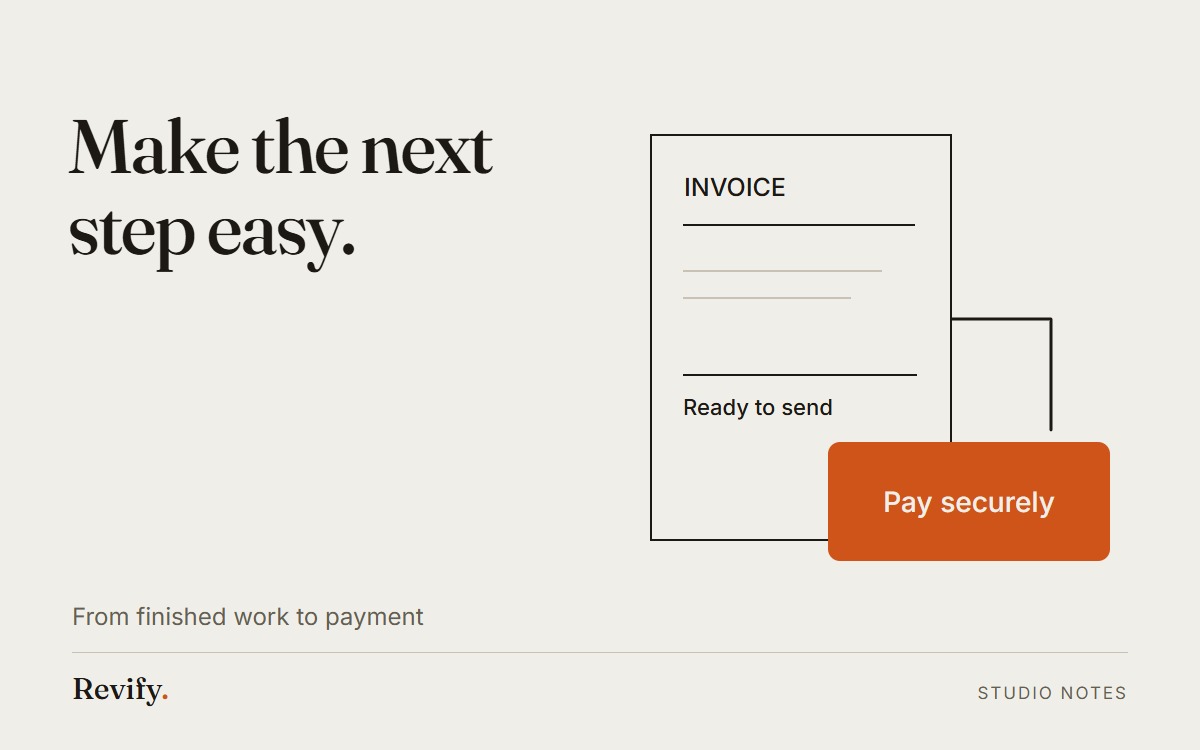
The tech marks the job complete in the field. A text goes to the homeowner from your business number: Thanks Dana - here is the invoice for today's water heater install, $1,840. Tap to pay by card or bank transfer. Followed by a short link.
The homeowner taps, sees a clean summary with your logo, pays with Apple Pay or a saved card in about fifteen seconds, and gets a receipt. Your dashboard shows paid. Nobody wrote anything down.
The reason this works is not technology, it is timing. You are asking while they are standing in a house with a working water heater and a positive feeling about your company. Two weeks later, in a stack of mail, that feeling is gone and your invoice is competing with the cable bill.
Setting it up
Stripe is the straightforward choice for most home-service shops. Standard card rates, no long contract, and it connects to nearly everything.
Decide what you are sending. For a fixed-price job, a payment link is enough - one amount, one description. For jobs with line items, warranties, or partial payments, send a proper hosted invoice so the homeowner sees the breakdown. Ambiguity on an invoice is the number one cause of it sitting unpaid.
Turn on wallets. Apple Pay and Google Pay remove the step where someone has to find their wallet, and that step is where a meaningful share of payments stall until later, which means never.
Offer ACH on large jobs. On a $14,000 roof, card fees are real money. A bank transfer option costs a fraction of that. Many homeowners will happily use it if you mention it.
Set up deposits. A link for the deposit at signing and a link for the balance at completion. This alone fixes most of the cash-flow strain on jobs where you front materials.
Connect it to your books. Stripe syncs to QuickBooks and Xero. If someone has to retype payments into the accounting system every Friday, the system will be abandoned by August.
The details people get wrong
Never take card numbers over text or a voicemail. Not the tech, not the office. If it comes in that way, delete it and send a link. A hosted payment page keeps the card data out of your systems entirely, and that is the entire point of the arrangement.
Do not add a card surcharge without checking. Surcharging is regulated, the rules vary by state and by card network, and getting it wrong is not worth the two percent. If you want to encourage cheaper payment methods, offer a discount for bank transfer instead - that path is generally cleaner. Talk to your processor first.
Make the description specific. Service call - $340 invites a phone call. Diagnostic and capacitor replacement, 4/18, Trane XR14 - $340 does not.
Add a tip line for service calls, not for projects. On a $180 drain clear it is often taken and appreciated by techs. On a $22,000 remodel it looks strange.
Write the reminder ladder once. Polite nudge at day 3, a second at day 10 that references the work done, then it becomes a human phone call. Automated reminders forever are how you become background noise.
Refund policy in writing, applied fast. The rare refund handled in an hour costs you a few hundred dollars. The same refund fought over for two weeks costs you a review.
What actually changes
Three things, and they compound.
Days to payment drops - often from weeks to same-day on service work. That is working capital you were previously lending to your customers for free.
The collections conversation mostly disappears. Nobody enjoys chasing money, and the person doing it in your office is usually someone whose time is worth more elsewhere.
And there is a quieter effect: paying you becomes easy and modern, which is one more small signal that you are a well-run company. Homeowners notice the same way they notice a clean truck.
Start with one job type. Service calls under a thousand dollars, text-to-pay only, for thirty days. Compare days-to-cash against the same period last year, then expand.
We wire payments into the customer journey we build behind the site - and the homepage itself is free to see first, in 48 hours.